

Our team has noticed a trend: a popular assumption that Hong Kong is empty. Well, not empty, but the belief holds that so many foreigners left after COVID that the housing market has availability and flexibility. This is increasingly misaligned with the current situation on the ground.
Hong Kong is a supply-constrained real estate market, especially in the serviced apartment market. It is only 430 square miles with over 7.5 million residents, making it one of the most densely populated regions in the world. With such limited living space, it is easy to understand that apartments tend to be small and expensive.
Belief in an expat exodus from Hong Kong could understandably lead to today’s view of the rental housing market. And in the wake of the combination of factors, including strict enforcement of covid restrictions, geopolitical realignments, and local unrest, there was a brief time when that held true. But 2026 is a long way from 2022 and much has changed.
Western expatriate numbers had declined sharply, but they were often replaced more than proportionally by other professionals and skilled migrants. This was by design of the Hong Kong government, which put into place several initiatives to revitalize the economy and increase global competitiveness by building a desirable local talent pool.
The Top Talent Pass Scheme (TTPS), launched in December of 2022, was particularly effective. Devised as a two-year visa for those in upper income brackets or with degrees from one of the world’s top 100 universities, the pass received over 200,000 applications and, as of May this year, approved more than 120,000. TTPS impact went further, permitting dependents to accompany them to study or work.
Many of the TTPS applications came from professionals in Mainland China. In fact, looking at overall VIA applications over the past 10 years, they have jumped considerably. But while the number of applicants from Mainland China has jumped, applications from other countries have remained relatively flat. This may also lend itself to Western companies just returning to the market to underestimate the situation.
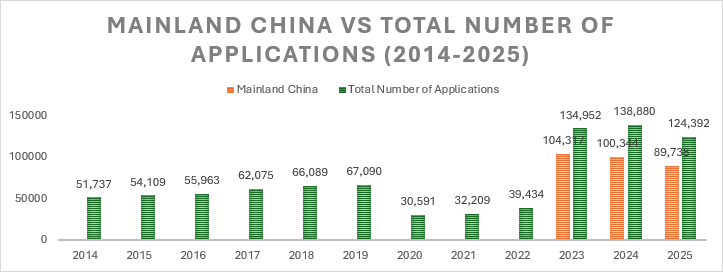
Mainland China included from 2014 – 2022, country reporting commenced only since 2023.
Regardless of the source of inbound talent, the multi-year increase in movement to Hong Kong has created a rental market that is both competitive and costly. Rents over the past two years have climbed as much as 10%, which is why it ranks amongst the most expensive cities in the world.
Current tenants are feeling the pinch at renewal time as well. Sharp increases in average rents have landlords eager to find new tenants, and there is little room for negotiation in lease renewals. Renewal price increases of 10–20% are becoming common. Recent examples include a 2024 – 2026 lease renewed for an additional year at HKD 58,500, an increase of HKD 5,500. We also recently negotiated a long-term tenant’s renewal, which began in 2023 at HKD 71,000, increased in 2025 to HKD 80,000, and, after lengthy negotiations, was renewed for an additional two years at HKD 82,800. (The new asking rental price was HKD 84,000)
Beyond high rent and renewal rates, the realities of a landlord market have other repercussions for assignees navigating the real estate market in Hong Kong. 
Quality properties will be leased quickly. Securing one will require quick action. Competition is high, but landlords are willing and able to wait to achieve the going market rate. This means landlords are often unwilling to hold units for future lease start dates, negotiation is limited, and preview housing tours are not supported as agents and landlords focus on those ready to make a decision.
Those challenges are topped by a lack of a reliable source to search online. In Hong Kong, there is no centralized, updated database of available rental properties. Often, old listings at yesterday’s prices remain on websites for advertising and are not representative of current market availability.
Old listings and outdated assumptions only hamper progress towards securing a home and waste valuable time. The idea that Hong Kong currently offers an abundance of housing supply is not only outdated, but it is also misleading. Employees prepared to act, with the proper documentation, funds in place, and local Destination Consultant support, will be well positioned in this market.



